Class 09 | Ganita Manjari 01 | Ch. 05 I’m Up and Down and Round and Round
Solutions
Think and Reflect (NCERT Textbook Page No. 93)
Question 1.
has a circular piece of paper. She is trying to locate its centre. Amina gives her a suggestion. She follows the instructions and is thrilled to find that it works. Can you guess what Amina told her?
Solution:
Amina could have suggested to:
- Fold the paper in half (from one side to the other, making sure the edges align).
- Crease the fold firmly.
- Unfold the paper. The crease will now represent a diameter of the circle.
- Fold the paper in half again, but this time, from the other direction (perpendicular to the first fold).
- Crease the second fold and unfold it.
Where the two creases intersect, that point is the centre of the circular paper. This method works because the folds create two perpendicular diameters, and their intersection is exactly at the centre of the circle.
Think and Reflect (NCERT Textbook Page No. 94)
Question 1.
What are the rotational symmetries of a square? How many lines of reflection symmetry does it have? What about a regular pentagon? A regular hexagon?
Solution:
(a) Square: A square is a quadrilateral with four equal sides and four 90° angles.

Rotational Symmetry: A square has a rotational symmetry of order 4.
This means it looks identical to its original state four times during a full 360° turn.
Lines of Reflection Symmetry: It has 4 lines of symmetry.
2 lines passing through the midpoints of opposite sides (Vertical and Horizontal).
2 lines passing through opposite vertices (Diagonals).
(b) Regular Pentagon: A regular pentagon has five equal sides and five equal interior angles (108° each).

Rotational Symmetry: It has an order 5 rotational symmetry.
It looks the same every time it is rotated by a multiple of 72° (
i.e., 72°, 144°, 216°, 288°, 360°.
Lines of Reflection Symmetry: It has 5 lines of symmetry.
Each line passes through one vertex and the midpoint of the opposite side.
(c) Regular Hexagon: A regular hexagon has six equal sides and six equal interior angles (120° each).

i.e., 60°, 120°, 180°, 240°, 300°, 360°.
Lines of Reflection Symmetry: It has 6 lines of symmetry.
3 lines passing through opposite vertices.
3 lines passing through the midpoints of opposite sides.
Question 2.
What is the length of the longest chord in a circle of radius 5 units? Is there a smallest chord?
Solution:
The longest chord in any circle is the diameter of the circle.
Diameter = 2 × Radius
= 2 × 5
= 10 units
So, the length of the longest chord of the circle is 10 units.
There is no smallest chord in a circle. As the two points on the circumference move closer together, the length of the chord approaches zero.
Question 3.
The locus of points at a given distance from a given point is a circle. What can we say about the locus of points equidistant from two given points?
(Hint: We know that any point that is equidistant from two given points A and B lies on the perpendicular bisector of AB. Does this make the perpendicular bisector the locus? For this, we have to show that all the points on the perpendicular bisector are equidistant from A and B.)
Solution:
Let the two given points be A and B. The set of all points that are equidistant from both A and B lies along a line, which is equidistant from both points.
This line is the perpendicular bisector of the line segment AB.
Given: Let A and B be two given fiAed points. PQ is the path traced out by the moving point P such that each point on it is equidistant from A and B.
Therefore, PA = PB.
To prove: PQ is the perpendicular bisector of the line segment AB.
Construction: Join A to B. Let PQ cut AB at O.

From ∆PAO and ∆PBO,
PA = PB (given)
AO = BO (since every point of PQ is equidistant from A and B, and O is a point on PQ)
PO = PO (common side)
Therefore, by the SSS criterion of congruence
∆PAO ≅ ∆PBO
Now ∠POA = ∠POB (since corresponding parts of congruent triangles are congruent)
Again ∠POA + ∠POB = 180° (since AOB is a straight line.)
Therefore, ∠POA = ∠POB = 90°
Also, PQ bisects AB (Since AO = BO)
Therefore, PQ ⊥ AB and PQ bisect AB, i.e., PQ is the perpendicular bisector of AB (Proved).
Hence, the locus of points equidistant from two given points is the perpendicular bisector of the line segment joining the two given points.
Think and Reflect (NCERT Textbook Page No. 95)
Question 1.
How many circles pass through two points on a plane?
Solution:
There are infinitely many circles that can pass through two points on a plane because the centre can be placed anywhere along the perpendicular bisector of the segment connecting the two given points.
Question 2.
Are there circles of all possible radii passing through A and B? What is the radius of the smallest circle passing through A and B? What is the radius of the largest circle passing through A and B?
Solution:
No, not all possible radii are possible. While there are an infinite number of circles, there is a minimum required radius. A circle must be large enough to at least reach from point A to point B. If a radius is too small (less than half the distance between the two points), the circle will not touch both points simultaneously. The smallest circle passing through A and B is the circle with the smallest radius that still passes through both points. This occurs when the centre of the circle lies at the midpoint of A and B, and the circle is exactly half the distance between A and B. The radius of the smallest circle is simply half the distance between A and B. The largest circle passing through A and B has no upper bound. As you move the centre of the circle farther away along the perpendicular bisector, the radius increases without limit. Therefore, the radius of the largest circle passing through A and B is infinite.
Question 3.
As you move away from segment AB along its perpendicular bisector, do the radii of the circles containing A and B increase or decrease?
Solution:
The perpendicular bisector of the line segment AB is the line that passes through the midpoint of AB and is perpendicular to it. The radius of the circle passing through A and B depends on the distance from the centre (which lies on the perpendicular bisector) to the points A and B. When the centre of the circle is closer to the midpoint of AB, the radius is smaller. As the centre moves further away from the midpoint along the perpendicular bisector, the distance to A and B increases, and therefore the radius increases. The radii of the circles containing A and B increase as you move away from the segment AB along its perpendicular bisector.u
Question 4.
As you go along the perpendicular bisector, will the circle drawn from that point through A and B appear more curved or. less curved?
Solution:
When the centre of the circle is closer to the midpoint of AB, the circle has a smaller radius, and it appears more curved. As the centre moves further away along the perpendicular bisector, the radius of the circle increases. A larger radius results in a less curved circle, meaning the circle appears to flatten out as the centre moves farther from AB. As you go along the perpendicular bisector, the circle drawn from that point through A and B will appear less curved as the radius increases.
Question 5.
You are given two points, A and B, on a plane. How many squares can you draw on the same plane with A and B on the boundary? How many squares can you draw on the plane with A and B as the corners of the square?
Solution:
(a) Point A and B on the boundary of the square: There are infinitely many squares that can be drawn with points A and B on their boundary. This is because the boundary of the square includes both its vertices and edges. As long as A and B lie anywhere along the four line segments that make up the square’s perimeter, the condition is satisfied. You can vary the size and rotation of the square such that its edges always pass through A and B.
(b) Point A and B on the corner of the square: If A and B are the corners of a square, there are exactly 3 possible squares that can be formed:
- Adjacent Vertices (2 Squares): A and B form one side of the square. Two squares can be formed by positioning them either above or below the line AB.
- Opposite Vertices (1 Square): A and B form the diagonal of the square. Only one unique square can be formed with A and B as opposite corners, with the centre of the square at the midpoint of AB.
Think, Draw, and Infer (NCERT Textbook Page No. 98)
Question 1.
A, B, and C are three collinear points. Can you find a point P such that PA = PB = PC? What can you say about the perpendicular bisectors of AB and BC? Draw and check. Can you show that for three collinear points A, B, and C, the perpendicular bisectors of AB and BC are parallel? Is it possible for a circle to pass through collinear points? Can you draw a line that cuts a given circle into three distinct points?
Solution:
A point P where PA = PB must lie on the perpendicular bisector of AB. Similarly, for PB = PC, point P must lie on the perpendicular bisector of BC. If the points A, B, and C are collinear, these two bisectors will never intersect, so no such point P exists. The perpendicular bisector of AB and the perpendicular bisector of BC will not meet at any point. For collinear points A, B, and C, the perpendicular bisectors of AB and BC will be parallel, because the line segments are perpendicular on the same line (since all points are on the same line).

A circle requires a curved path, and for any three points to lie on the same circle, they must not be collinear. Three collinear points cannot lie on a single circle because a circle requires the points to form a non-straight curve. Therefore, a circle can’t pass through collinear points. In general, a line can intersect a circle at most two distinct points. So, a single straight line can’t intersect a circle at three distinct points. Draw yourself.
Question 2.
The circumcircle of a given ΔABC is drawn. Can there be other triangles congruent to ΔABC that share the same circumcircle?
Solution:
Yes, there can be other triangles congruent to ΔABC that share the same circumcircle. Since a circumcircle only defines the positions of the vertices and not the orientation, the triangle can be rotated or reflected around the circumcentre to create other congruent triangles. These new triangles will still share the same circumcircle as the original triangle ΔABC.
Exercise (NCERT Textbook Page No. 107)
Question 1.
A circle with centre O is drawn, and A, B, C, D are points on the circle (See Figure). Measure the angles subtended by arc AKB and arc CLD at the centre O. If the angle at the centre is less than 180°, it is a minor arc. If the angle at the centre is greater than 180°, it is a major arc. State whether arcs AKB and CLD are minor arcs or major arcs.

Solution:
Do it yourself.
Exercise (NCERT Textbook Page No. 113)
Question 1.
A cyclic quadrilateral ABCD has angles measuring ∠A = 80°, ∠B = 110°, ∠C = 100°, and ∠D = 70°. Can such a quadrilateral be drawn? Explain why or why not.
Solution:
For a cyclic quadrilateral, opposite angles are supplementary.
That is, ∠A + ∠C = 180° and ∠B + ∠D = 180°
Now check the given angles:
∠A + ∠C = 80° + 100°= 180°
and ∠B + ∠D = 110° + 70° = 180°
Both pairs of opposite angles are supplementary.
Therefore, such a cyclic quadrilateral can be drawn.
Class 9 Maths Ganita Manjari Chapter 5 Exercise Set 5.1 Solutions
Exercise Set 5.1 Class 9 Maths Solutions
Question 1.
Draw ∆ABC with AB = 5 cm, ∠A = 70°, and ∠B = 60°. Draw the circumcircle of ∆ABC. Is the centre inside or outside the triangle?
Solution:
In ∆ABC, AB = 5 cm, ∠A = 70°, ∠B = 60°
Steps of Construction:
1. Draw a line segment AB with a length of 5 cm.
2. Using a protractor, draw an angle of 70° at point A.
3. Using a protractor, draw an angle of 60° at point B.
4. The intersection of the two arms of these angles will be point C.
5. Draw perpendicular bisectors of AB, BC, and AC.
6. The point where all three perpendicular bisectors meet is the circumcentre O.
7. Taking O as centre and OA as radius, draw the circumcircle of ∆ABC.

Question 2.
Draw ∆ABC with AB = 5 cm, ∠A = 100°, and AC = 4 cm. Draw the circumcircle of ∆ABC. Is the centre inside or outside the triangle?
Solution:
In ∆ABC, AB = 5 cm, ∠A = 100°, AC = 4 cm.
Steps of Construction:
1. Draw a line segment AB with a length of 5 cm.
2. Using a protractor, draw an angle of 100° at point A.
3. Taking point A as centre and a radius of 4 cm, draw an arc at the other arm of ∠A intersecting it at point C.
4. Join the line segment BC.
5. Draw perpendicular bisectors of AB, BC, and AC.
6. The point where all three perpendicular bisectors meet is the circumcentre O.
7. Place the compass at circumcentre O, taking it as centre, draw a circle of radius OA that passes through points A, B, and C.
This is the circumcircle of ∆ABC.
The circumcentre (the centre of the circumcircle) is outside the triangle.

Draw ∆ABC, with AB = 6 cm, BC = 7 cm, and CA = 7 cm. Draw the circumcircle of ∆ABC. Let the circumcentre be O. Measure OA, OB, and OC.
Solution:
In ∆ABC, AB = 6 cm, BC = 7 cm, CA = 7 cm
Steps of Construction:
1. Draw a line segment AB with a length of 6 cm.
2. Taking centre as point A, draw an arc of radius 7 cm, and taking centre as point B, draw an arc of radius 7 cm. Mark the point of intersection of these as point C.
3. Join the line segments AC and BC.
4. Draw perpendicular bisectors of AB, BC, and AC.
5. The point where all three perpendicular bisectors meet is the circumcentre O.

6. Using a compass, take the circumcentre as the centre O and draw a circle of radius OA that passes through points A, B, and C. This is the circumcircle of ∆ABC.
Since the circumcentre is equidistant from all three vertices, OA, OB, and OC will all have the same length. This distance is the radius of the circumcircle.
OA = OB = OC = 3.85 cm approx.
Question 4.
What is the least possible radius of a circle through two points A and B?
Solution:
For any two points A and B, there are infinitely many circles that can pass through both points, and the radius of these circles can vary depending on the position of the centre of the circle. The smallest circle that can pass through A and B is the one where the line segment AB is the diameter of the circle. The radius of this circle is half the length of the line segment AB.
Class 9 Maths Ganita Manjari Chapter 5 Exercise Set 5.2 Solutions
Exercise Set 5.2 Class 9 Maths Solutions
Question 1.
Show that the triangle formed by a chord and the centre of the circle is isosceles.
Solution:
Given: A circle with centre O and chord AB of the circle. Points A and B are on the circumference of the circle.
To prove: ∆OAB is isosceles, i.e., OA = OB.

Proof: In a circle, the distance from the centre O to any point on the circle is always the radius of the circle.
Therefore, OA and OB are both radii of the circle.
Since OA and OB are both radii of the same circle, we can say that OA = OB
This means the two sides of ∆OAB are equal in length.
Since OA = OB, ∆OAB has two equal sides, making it an isosceles triangle.
Therefore, the triangle formed by a chord AB and the centre O of the circle is isosceles because the two sides OA and OB are equal in length.
Question 2.
Show that if two such isosceles triangles (occurring in the previous question) have equal base length, they are congruent to each other.
Solution:
Given: Two isosceles triangles, OAB and OCD, are formed by the chords AB and CD of the same circle, with O as the centre.
The two triangles have equal base lengths, i.e., AB = CD.
To prove: ∆OAB ≅ ∆OCD

Proof: In ∆OAB and ∆OCD,
OA = OD (Radii of the circles are equal)
AB = CD (Equal base length)
OB = OC (Radii of the circles are equal)
∆OAB ≅ ∆OCD (By SSS congruence criterion)
Therefore, if two isosceles triangles formed by the centre of the circle and the chords AB and CD have equal base lengths, then they are congruent to each other.
Class 9 Maths Ganita Manjari Chapter 5 Exercise Set 5.3 Solutions
Exercise Set 5.3 Class 9 Maths Solutions
Question 1.
Can you explain why the converse to Theorem 4 is true, i.e., why does the perpendicular from the centre of a circle to a chord of the circle bisect the chord?
(Hint: Use Figure. You are told that ∠CMA = ∠CMB = 90°. You need to show that AM = BM)
Solution:
Given: C is the centre, and AB is the chord of the circle.
CM ⊥ AB and ∠CMA = ∠CMB = 90°.
To prove: AM = BM

Proof: In ∆CMA and ∆CMB,
CM = CM (Common)
CA = CB (Radii of the circle are equal)
∠CMA = ∠CMB = 90° (Given)
∆CMA ≅ ∆CMB (By the RHS congruence criterion)
AM = BM (CPCT)
Therefore, the perpendicular line from the centre of a circle bisects the chord.
Question 2.
An isosceles triangle ABC is inscribed in a circle, with AB = AC. Show that the altitude from A to BC passes through the centre of the circle.
Solution:
Given: ABC is the isosceles triangle inscribed in the circle with centre O.
AM is the altitude from A to BC.
To prove: Altitude AM passes through the centre, i.e., AOM is the straight line

Proof: In ∆AMB and ∆AMC,
AM = AM (Common)
AB = AC (∆ABC is the isosceles triangle)
∠AMB = ∠AMC = 90° (AM is the altitude to BC)
∆AMB ≅ ∆AMC (By RHS congruence criterion)
BM = CM (CPCT)
By theorem, the line joining the centre of a circle (O) and the midpoint (M) of a chord of the circle is perpendicular to the chord (BC).
Therefore, the line OM is perpendicular to BC.
Since OM is perpendicular to BC and AM is perpendicular to BC, the two lines AM and OM must coincide because both must pass through the midpoint M and be perpendicular to BC.
Thus, AM and OM are the same line; AOM is a straight line.
Therefore, the altitude AM passes through the centre O of the circle.
Hence, the altitude from A to BC passes through the centre of the circle.
Question 3.
Two parallel chords of lengths 6 cm and 8 cm are on opposite sides of the centre of a circle. If the radius of the circle is 5 cm, find the distance between the midpoints of the chords.
Solution:
Given: Radius of the circle = 5 cm, AB = 6 cm, CD = 8 cm

To find: Length of MN
Let N be the midpoint of chord AB.
Since the perpendicular bisects the chord.
AN =
Using a theorem, the line joining the centre of a circle and the midpoint of a chord of the circle is perpendicular to the chord.
In a right-angled ∆ANO,
OA2 = ON2 + AN2 (by Baudhayana-Pythagoras theorem)
⇒ 52 = ON2 + 32
⇒ 25 = ON2 + 9
⇒ ON2 = 16
⇒ ON = 4 cm
Let M be the midpoint of chord CD.
Since the perpendicular bisects the chord.
CM =
Using a theorem, the line joining the centre of a circle and the midpoint of a chord of the circle is perpendicular to the chord.
In a right-angled ∆CMO,
OC2 = OM2 + CM2 (by Baudhayana-Pythagoras theorem)
⇒ 52 = OM2 + 42
⇒ 25 = OM2 + 16
⇒ OM2 = 9
⇒ OM = 3 cm
Length of MN = OM + ON
= 3 cm + 4 cm
= 7 cm
Therefore, the distance between the midpoints of the chord is 7 cm.
Class 9 Maths Ganita Manjari Chapter 5 Exercise Set 5.4 Solutions
Exercise Set 5.4 Class 9 Maths Solutions
Question 1.
Use the Baudhayana-Pythagoras theorem to show why Theorem 6 must be true.
Solution:
Given: Circle with centre O and two equal chords AB = CD, OP ⊥ AB and OQ ⊥ CD.
To prove: OP = OQ
Proof: Using the theorem, the perpendicular from the centre of a circle to a chord bisects the chord.
Since AB = CD
⇒ AP =
⇒ AP = CQ
Let OA = OC = r (radius of the circle)
Baudhayana-Pythagoras theorem states that in a right-angled triangle, the square of the hypotenuse is equal to the sum of the squares of the other two sides.

In the right-angled ∆OPA,
OP2 + AP2 = OA2
⇒ OP2 + AP2 = r2 …(i)
In the right-angled ∆OQC,
OQ2 + CQ2 = OC2
⇒ OQ2 + CQ2 = r2 …..(ii)
From (i) and (ii)
OP2 + AP2 = OQ2 + CQ2
⇒ OP2 = OQ2 (AP = CQ ⇒ AP2 = CQ2)
⇒ OP = OQ
Therefore, chords of a circle having the same length are all at the same distance from the centre of the circle.
Question 2.
Consider Fig. 5.15. If CE is perpendicular to AB, CH is perpendicular to GH, and CE = CH, show that AB = GF.

Solution:
Given: Circle with centre C, CE ⊥ AB, CH ⊥ GF, and CE = CH.
To prove: AB = GF

Proof: Using the theorem, equal chords of a circle subtend equal angles at the centre of the circle.
∠BCA = ∠GCF
In ∆BCA and ∆GCF
GC = CF, CF = CA (radius of circle)
∠BCA = ∠GCF
∴ ∆BCA = ∆GCF by SAS congruence criterion
Thus, GF = AB (by CPCT) (Proved)
Question 3.
Solve the previous question using the Baudhayana-Pythagoras theorem.

Solution:
Given: Circle with centre C, CE ⊥ AB, CH ⊥ GF, and CE = CH.
To prove: AB = GF

Proof: Baudhayana Pythagoras theorem states that in a right-angled triangle, the square of the hypotenuse is equal to the sum of the squares of the other two sides.
Let Radii CA = CG = r, and lengths CE = CH = d
In the right-angled ∆CEA,
CA2 = CE2 + AE2 (by Baudhayana-Pythagoras theorem)
EA2 = CA2 – CE2
EA2 = r2 – d2 ……(i)
In the right-angled ∆CHG,
CG2 = CH2 + GH2 (by Baudhayana-Pythagoras theorem)
GH2 = CG2 – CH2
GH2 = r2 – d2 …..(ii)
From (i) and (ii)
EA2 = GH2
⇒ EA = GH
A perpendicular from the centre of a circle to a chord bisects the chord.
∴ AB = 2 × EA
GF = 2 × HG
Since EA = GH, we have AB = GF (proved).
Class 9 Maths Ganita Manjari Chapter 5 Exercise Set 5.5 Solutions
Exercise Set 5.5 Class 9 Maths Solutions
Question 1.
Find the length of the chord of a circle where the radius is 7 cm, and the perpendicular distance is 6 cm.
Solution:
Given: Radius = OA = 7 cm,
Perpendicular distance = OP = 6 cm
To find: Length of chord, i.e., AB

In the right-angled ∆OPA,
OA2 = OP2 + AP2 (by Baudhayana-Pythagoras theorem)
⇒ 72 = 62 + AP2
⇒ 49 = 36 + AP2
⇒ AP2 = 49 – 36 = 13
⇒ AP = √13 cm
Since the perpendicular distance bisects the chord.
AB = 2 × AP = 2 × √13 = 7.21 cm
Therefore, the length of the chord is approximately 7.21 cm.
Question 2.
Explain why the following statement is true: If the perpendicular distance of a chord from the centre is d and the radius is r, then the chord length is
Solution:
Given: d be the perpendicular distance from the centre of the circle to the chord, and r be the radius of the circle.
To prove: Length of the chord =
Proof: OA = r, OM = d

In the right-angled ∆OMA,
OA2 = OM2 + AM2 (by Baudhayana-Pythagoras theorem)
⇒ r2 = d2 + AM2
⇒ AM2 = r2 – d2
⇒ AM =
Since the perpendicular distance bisects the chord,
AB = 2 × AM =
Therefore, the length of the chord is
Question 3.
In a circle, if the distance of chord AB from the centre is twice the distance of another chord CD from the centre, can we conclude that CD = 2AB? Give reasons for your answer.
Solution:
No, we cannot conclude that CD = 2AB just because the distance of chord AB from the centre is twice the distance of chord CD.
For a circle of radius R, if a chord is at a perpendicular distance d from the centre, then the length of the chord =
Let the distance of chord AB from the centre be 2x.
Let the distance of chord CD from the centre be x.
AB =
CD =
The relationship between AB and CD depends on the radius R and the value of x.
Clearly, CD is not necessarily equal to 2AB because
This ratio is not a constant 2; it varies and x.
Class 9 Maths Ganita Manjari Chapter 5 Exercise Set 5.6 Solutions
Exercise Set 5.6 Class 9 Maths Solutions
Question 1.
In a circle with centre O, the central angle AOB is 60°. If the radius of the circle is 12 cm, what is the length of the chord AB?
Solution:
In a circle with centre O and radius OA = OB = 12 cm, if OA and OB are both equal then triangle OAB is an isosceles triangle.
The sum of angles in any triangle is 180°.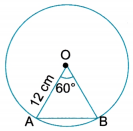
In an isosceles triangle, the angles opposite equal sides are also equal (∠OAB = ∠OBA).
Let ∠OAB = ∠OBA = x.
So, x + x + 60°= 180°
⇒ 2x = 120°
⇒ x = 60°
Since all three interior angles are 60°, triangle AOB is an equilateral triangle.
In an equilateral triangle, all three sides are equal in length:
OA = OB = AB = 12 cm
Therefore, the length of chord AB is 12 cm.
Question 2.
Let A and B be two points on a circle with centre O.
(i) Are there points X, Y on the circle, on the same side of AB, such that ∠AXB is different from ∠AYB?
(ii) Is it true that if ∠AXB = ∠AYB, then X and Y lie on the same side of the circle?
(iii) If ∠AXB = ∠AYB, and X and Y do not lie on the circle, does the circle through A, B, and X also pass through Y?
Solution:
(i) No, because all angles subtended by an arc on the same side of the circle are equal.
So, if X and Y are on the same side of chord AB, then ∠AXB = ∠AYB.
Therefore, they can’t be different.
(ii) No, it is not necessarily true. X and Y could lie on opposite sides of the circle if AB is the diameter.
In that case, both angles will be 90°, regardless of which side X and Y are on.
(iii) Yes, the circle through A, B, and X also passes through Y, provided X and Y are on the same side of AB.
Question 3.
Find x in Fig. 5.26.

Solution:
∠ADC = 100°
∴ Angle subtended by arc ABC on the centre = 2 × 100° = 200°
Since the sum of the angles subtended by major and minor arcs at the centre is 360°.
Therefore, the angle subtended by arc ADC on the centre = 360° – 200°= 160°.
Thus, ∠x =
Class 9 Maths Chapter 5 End of Chapter Exercises Solutions
I’m Up and Down and Round and Round End of Chapter Exercises Solutions
Question 1.
In a circle, a chord is 5 cm away from the centre. If the radius of the circle is 13 cm, what is the length of the chord?
Solution:
Given: Radius = OA = 13 cm,
Distance of chord from centre = OP = 5 cm
To find: Length of chord, i.e., AB

In the right-angled ∆OPA,
OA2 = OP2 + AP2 (by Baudhayana-Pythagoras theorem)
⇒ 132 = 52 + AP2
⇒ 169 = 25 + AP2
⇒ AP2 = 169 – 25 = 144
⇒ AP = √144 = 12 cm
Since the perpendicular distance bisects the chord,
AB = 2 × AP = 2 × 12 = 24 cm
Therefore, the length of the chord is 24 cm.
Question 2.
An arc of a circle subtends an angle of 70° at the centre. What is the measure of the angle subtended by the arc at a point on the circle?
Solution:
The angle subtended by an arc at the centre of a circle is double the angle subtended by it at any point on the circle outside the arc.
Angle at the centre = 70°
Angle at the circumference =
Therefore, the angle subtended by the arc at a point on the circle outside the arc is 35°.
(If the point is on the circle but lies on the arc, then the angle will be 180° – 35° = 145°)
Question 3.
The diameter of a circle is 26 cm. A chord of length 24 cm is drawn in the circle. Find the distance from the centre of the circle to the chord.
Solution:
Given: Diameter = AC = 26 cm, Chord AB = 24 cm

To find: Distance between the length of the chord and the centre i.e., OP
Radius (OA) =
A perpendicular line drawn from the centre of a circle to a chord bisects the chord.
AP =
In the right-angled ∆OPA,
⇒ OA2 = OP2 + AP2 (by Baudhayana-Pythagoras theorem)
⇒ 132 = OP2 + 122
⇒ 169 = OP2 + 144
⇒ OP2 = 169 – 144 = 25
⇒ OP = 5 cm
Therefore, the distance from the centre of the circle to the chord is 5 cm.
Question 4.
A circle has a radius of 15 cm. A chord is drawn. The distance from the centre of the circle to the chord is 9 cm. What is the length of the chord?
Solution:
Given: Radius = OA = 15 cm,
Distance of the chord from centre = OP = 9 cm
To find: Length of chord, i.e., AB

In the right-angled ∆OPA,
OA2 = OP2 + AP2 (by Baudhayana-Pythagoras theorem)
⇒ 152 = 92 + AP2
⇒ 225 = 81 + AP2
⇒ AP2 = 225 – 81 = 144
⇒ AP = √144 = 12 cm
Since the perpendicular distance bisects the chord,
AB = 2 × AP = 2 × 12 = 24 cm
Therefore, the length of the chord is 24 cm.
Question 5.
Prove that the perpendicular bisector of a chord passes through the centre of the circle.
Solution:
Given: A circle with centre O.
A line L is the perpendicular bisector of AB.
L passes through the midpoint of AB and is perpendicular to AB.
To prove: Centre O lies on the line L.

Proof: In ∆AOM and ∆BOM,
OM = OM (Common)
OA = OB (Radii of the circle)
AM = BM (A line from the centre to a chord bisects the chord)
∆AOM = ∆BOM (By SSS congruence criterion)
∠OMA = ∠OMB (CPCT) …..(i)
AMB is a straight line.
∠OMA + ∠OMB = 180°
⇒ 2 × ∠OMA = 180° (from (i))
⇒ ∠OMA = 90°
Line segment OM is perpendicular to AB, and M is the midpoint of AB.
Thus, OM is the perpendicular bisector of the chord.
Since there is a unique perpendicular bisector for any line segment, the line L (our perpendicular bisector) must be the same line as OM.
Therefore, the centre O must lie on line L.
Question 6.
The diameter of a circle is AB. Point C is on the circumference. What is the measure of the ∠ACB? Explain your reasoning.
Solution:
Given: AB is the diameter of the circle.
C is a point on the circumference of the circle.
∠ACB is the angle subtended by the diameter AB at the point C on the circumference.
To find: The measure of ∠ACB.
Since AB is the diameter of the circle and C is a point on the circumference, the angle ∠ACB is subtended by the diameter AB.
By the corollary of Theorem 9, the angle subtended by the diameter at any point on the circumference of the circle is always a right angle.
Therefore, the measure of ∠ACB is 90°.
Question 7.
ABCD is a cyclic quadrilateral inscribed in a circle. If ∠A measures 75°, what is the measure of ∠C? If ∠B measures 110°, what is the measure of ∠D?
Solution:
Given: ABCD is a cyclic quadrilateral inscribed in a circle.
∠A = 75°, ∠B = 110°
To Find: The measure of ∠C and ∠D
For any cyclic quadrilateral (a quadrilateral inscribed in a circle), the sum of the opposite angles is always 180°.
∠A + ∠C = 180° and ∠B + ∠D = 180°
Since ∠A + ∠C = 180°
⇒ ∠C = 180° – ∠A = 180° – 75°= 105°
Similarly, since ∠B + ∠D = 180°
⇒ ∠D = 180° – ∠B = 180° – 110° = 70°
The measure of ∠C is 105°, and ∠D is 70°.
Question 8.
Quadrilateral PQRS is inscribed in a circle. If ∠P = (2x + 10)° and ∠R = (3x – 20)°, find the value of x and the measures of ∠P and ∠R.
Solution:
Quadrilateral PQRS is inscribed in a circle.
∠P = (2x + 10)° and ∠R = (3x – 20)°
In a cyclic quadrilateral, opposite angles add up to 180°.
∠P + ∠R = 180°
⇒ (2x + 10) + (3x – 20) = 180
⇒ 2x + 10 + 3x – 20 = 180
⇒ 5x – 10 = 180
⇒ 5x = 190
⇒ x = 38
∠P= 2x + 10 = 2(38) + 10 = 76 + 10 = 86°
∠R = 3x – 20 = 3(38) – 20 = 114 – 20 = 94°
Question 9.
The distance of a chord of length 16 cm from the centre of a circle is 6 cm. Find the radius of the circle.
Solution:
Given: The length of the chord AB = 16 cm, the perpendicular distance from the centre of the circle O to the chord AB = 6 cm.
To find: Radius of the circle (r).
P is the midpoint of chord AB.

Since OP is the perpendicular distance from the centre to the chord, P divides the chord AB into two equal parts.
Therefore, the length of AP =
In a right-angled ∆OPA,
OA2 = OP2 + AP2 (by Baudhayana-Pythagoras theorem)
⇒ r2 = 62 + 82
⇒ r2 = 36 + 64 = 100
⇒ r = 10 cm
Therefore, the radius of the circle is 10 cm.
Question 10.
A cyclic quadrilateral has sides 5, 5, 12, 12 units. Find its area.
Solution:
Let ABCD be the cyclic quadrilateral with AB = BC = 5, CD = DA = 12
Since there are two pairs of adjacent equal sides, ABCD is a kite. Join BD.

In a kite, the triangles formed by joining the vertices between unequal sides are congruent:
∠ABD ≅ ∠CBD
So, ∠BAD = ∠BCD
But in a cyclic quadrilateral, opposite angles are supplementary:
∠BAD + ∠BCD = 180°
Since they are equal,
∠BAD = ∠BCD = 90°
Thus, ∆ABD is a right triangle with legs AB = 5, AD = 12
Hence, Area of ∆ABD =
Since ∠ABD ≅ ∠CBD,
Area of ∆CBD = 30 square units
Therefore, the area of quadrilateral ABCD = 30 + 30 = 60 square units.
Question 11.
Consider a cyclic quadrilateral. Without drawing its circumcircle, how can we find out whether the centre of the circumcircle lies inside the quadrilateral or outside? What is the best way of finding out?
Solution:
Let ABCD be a cyclic quadrilateral and let O be the centre of its circumcircle.
Take one side, say AB, as a chord.
Now look at the angle made by this chord at the opposite vertex C: ∠ACB
This is the angle subtended by chord AB at the circumference.
We know that the angle subtended by the same chord at the centre is twice this angle.
Therefore, ∠AOB = 2∠ACB
Now the key idea is:
- If ∠ACB < 90°, then ∠AOB < 180°, so O and C lie on the same side of chord AB.
- If ∠ACB > 90°, then ∠AOB > 180°, so O and C lie on opposite sides of chord AB.
- If ∠ACB = 90°, then AB is a diameter, so O lies on AB.
So, for each side of the quadrilateral, do this:
- for AB, check ∠ACB
- for BC, check ∠BDC
- for CD, check ∠CAD
- for DA, check ∠DBA
If the centre lies on the same side of every side as the interior of the quadrilateral, then the centre is inside.
If for at least one side it lies on the opposite side, then the centre is outside.
Question 12.
When two chords intersect, each of them is divided into two line segments. Show that if the intersecting chords are of equal length, then the line segments of one chord are equal to the corresponding line segments of the other chord.
Solution:
Given: Let chords AB and CD intersect at point E inside a circle with centre O.
Draw perpendiculars OM and ON from O to chords AB and CD, respectively. Join OE.
To prove: AE = CE, BE = DE

Proof: Since equal chords are equidistant from the centre.
OM = ON
Also, perpendiculars from the centre bisect the chords.
AM = MB, CN = ND
In a right-angled ∆OME and ∆ONE,
OM = ON (Equal chords are equidistant)
OE = OE (Common)
∠OME = ∠ONE = 90°
∆OME ≅ ∆ONE (RHS congruence rule)
ME = NE (CPCT)
AE = AM + ME
CE = CN + NE
Since AM = CN and ME = NE (from congruence)
⇒ AE = CE
BE = MB – ME
DE = ND – NE
Since MB = ND and ME = NE
⇒ BE = DE
The line segments of chord AB (AE, BE) are equal to the corresponding segments of chord CD (CE, DE).
Therefore, if two equal chords intersect inside a circle, they are divided into equal corresponding segments.
Question 13.
Draw a circle in which a chord of 6 cm length stands at a distance of 3 cm from the centre.
(Hint: Is it a circumcircle of a suitable triangle?)
Solution:
Length of the chord (AB) = 6 cm
Distance from centre to the chord (OP) = 3 cm

Steps:
Draw a line segment AB = 6 cm.
Construct the perpendicular bisector PE of AB.
Let PE intersect AB at P.
Since the centre of a circle lies on the perpendicular bisector of its chord, the centre of the required circle must lie on line PE.
With P as centre and radius 3cm, cut an arc on PE to locate a point O. Join OB.
Taking O as the centre and OB as the radius, draw a circle.
The obtained circle is the required circle passing through A and B.
Question 14.
Show that rectangle is the only parallelogram that can be inscribed in a circle.
Solution:
Given: A parallelogram ABCD is inscribed in a circle.
To prove: The parallelogram ABCD is a rectangle.

Proof: In a circle, the opposite angles of a cyclic quadrilateral are supplementary.
∠A + ∠C = 180° and ∠B + ∠D = 180°
In a parallelogram, the opposite angles are equal.
So, ∠A = ∠C
and ∠B = ∠D
Since ∠A = ∠C
and ∠A + ∠C = 180°
⇒ 2∠A = 180°
⇒ ∠A = 90°
All angles of the parallelogram are right angles.
Therefore, a rectangle is the only parallelogram that can be inscribed in a circle.
Question 15.
Show that if a rectangle is inscribed in a circle, then the point of intersection of its diagonals must lie at the centre of the circle.
Solution:
Given: A rectangle ABCD is inscribed in a circle, and its diagonals AC and BD intersect at point O.
To prove: The point O lies at the centre of the circle.

Proof: In a rectangle, the diagonals are equal and bisect each other.
So, AO = CO and BO = DO.
Since the rectangle is inscribed in a circle, all four vertices A, B, C, D lie on the circle.
Here AC is a chord and ∠ABC = 90° (angle of a rectangle).
So, AC is the diameter of the circle, since the angle made by the chord of the circle is a right angle.
Similarly, BD is also a diameter.
The diagonals AC and BD are chords of the circle that intersects at O.
Because O is equidistant from all four vertices, it must be the centre of the circle.
Hence, if a rectangle is inscribed in a circle, the intersection point of its diagonals coincides with the centre of the circle.
Question 16.
Consider all chords of a circle of a fixed length. What is the shape formed by the midpoints of all these chords?
Solution:
If you draw many chords of the same length inside a circle, and mark the middle point of each chord, all those midpoints will form a smaller circle inside the big one. This smaller circle has the same centre as the big circle, so it is called a smaller concentric circle.
Question 17.
In a circle with centre O, chords AB and AC are congruent. Explain why this statement is true: “The centre of the circle lies on the angle bisector of ∠BAC”.
Solution:
Given: A circle with centre O,
Chords AB = AC (congruent)
To prove: The centre O lies on the angle bisector of ∠BAC, i.e., ∠BAO = ∠OAC

Proof: In a circle, all radii are equal.
So, OA = OB = OC
In triangles ∆AOB and ∆AOC,
OA = OA (Common side)
OB = OC (Radii of the circle)
AB = AC (Given congruent chords)
∴ ∆AOB ≅ ∆AOC (By SSS congruence rule)
⇒ ∠BAO = ∠CAO (CPCT)
This means line AO bisects ∠BAC.
Therefore, the centre of the circle lies on the angle bisector of ∠BAC.
Question 18.
Two parallel chords of lengths 10 cm and 24 cm are on the same side of the centre of a circle. The distance between the chords is 7 cm. Find the radius of the circle.
Solution:

Let O be the centre of the circle and r be the radius.
Chord 1 (AB) = 10 cm
Chord 2 (PQ) = 24 cm
A perpendicular line drawn from the centre of a circle to a chord bisects that chord.
MQ = 12 cm and NB = 5 cm
Let x be the distance from the centre O to the chord PQ.
Since the distance between the chords is 7 cm, the distance from the centre to the chord AB is x + 7.
In right-angled ∆OMQ,
r2 = x2 + 122 (by Baudhayana Pythagoras theorem)
⇒ r2 = x2 + 144 …..(i)
In right-angled ∆ONB,
r2 = (x + 7)2 + 52 (by Baudhayana-Pythagoras theorem)
⇒ r2 = x2 + 14x + 49 + 25
⇒ r2 = x2 + 14x + 74 …(ii)
From (i) and (ii),
x2 + 144 = x2 + 14x + 74
⇒ 144 = 14x + 74
⇒ 14x = 144 – 74 = 70
⇒ x = 5 cm
Put x = 5 cm in equation (i)
r2= 52 + 144 = 25 + 144 = 169
⇒ r = √169 = 13 cm
Therefore, the radius of the circle is 13 cm.
Question 19.
A regular hexagon is inscribed in a circle of radius r. Find the length of the sides of the hexagon and the distance of each side from the centre of the circle.
Solution:
Let ABCDEF be a regular hexagon inscribed in a circle with centre O and radius r.
Since, the hexagon is regular, AB = BC = CD = DE = EF = FA
We know that equal chords of a circle subtend equal angles at the centre.

Therefore, ∠AOB = ∠BOC = ∠COD = ∠DOE = ∠EOF = ∠FOA
These six central angles together make a complete angle around the centre.
Hence, each central angle is
So, ∠AOB = 60°
Also, OA = OB = r (radii of the same circle)
Thus, in ∠AOB, OA = OB, and ∠AOB = 60°
Therefore, the remaining two angles are equal and together measure = 180° – 60° = 120°
Hence, each remaining angle is 60°.
So, all three angles of ∆AOB are 60°.
Therefore, ∆AOB is equilateral.
Hence, AB = OA = OB = r
Therefore, each side of the regular hexagon is r.
Let M be the midpoint of side AB, and the distance of the chord from the centre is d.
AM is
Therefore, the length of each side: r
Distance from the centre:
Question 20.
A quadrilateral MNOP is inscribed in a circle. If MN is a diameter, what can you say about ∠MOP and ∠MNP? Explain your reasoning.
Solution:
∠MOP and ∠MNP are equal.
MN is the diameter of the circle, and MNOP is a quadrilateral inscribed in a circle.

Using the theorem, the angle subtended by an arc at the centre of the circle is double the angle subtended by the arc at any point on the circle outside the arc.
Arc is MXP, then 2∠MOP = ∠MCP and 2∠MNP = ∠MCP
⇒ ∠MOP = ∠MNP
Question 21.
Let ABCD be a cyclic quadrilateral. Explain why the exterior angle at any vertex is equal to the interior opposite angle (e.g., ∠CDE = ∠ABC, where E is a point on the extension of side CD).
Solution:
Given: In a cyclic quadrilateral ABCD, side CD is produced to a point E.
To prove: ∠ADE = ∠ABC

Proof: ∠CDA + ∠ADE = 180° (Linear Pair)
∠ABC + ∠ADC = 180° (Opposite angles of a cyclic quadrilateral are supplementary.)
Equating both the cases, we get ∠CDA + ∠ADE = ∠ABC + ∠ADC
∠ADE = ∠ABC
Question 22.
“There is no chord of a circle that is longer than its diameter.” How do you justify this statement?
Solution:
Consider a circle with centre O and radius r.
Let AB be any chord in the circle.

In any triangle, the sum of any two sides must be greater than the third side.
OA + OB > AB
⇒ r + r > AB
⇒ 2r > AB
Since 2r is the diameter, the diameter must be greater than the chord AB.
We know that 2r is the length of the diameter.
2r > AB tells us that the diameter is always longer than any chord that does not pass through the centre.
If a chord passes through the centre, it is a diameter, and its length is exactly 2r.
Thus, no chord can ever exceed the length of the diameter; the diameter is the maximum possible distance between any two points on the circle’s circumference.
Question 23.
Let A be any point within a given circle with centre O. Show that the shortest chord of the circle that passes through point A is the one that is perpendicular to OA.
Solution:
Given: Circle with centre O and point A inside the circle.
Chord PQ passing through A such that OA ⊥ PQ.
Any other chord RS passing through A (not perpendicular to OA).
To prove: PQ < RS

Contraction: Draw OM ⊥ RS, where M is a point on RS.
Proof: Since OM ⊥ RS (by construction)
∆OMA is a right-angled triangle with the right angle at M.
In a right-angled triangle, the hypotenuse is the longest side.
In ∆OMA, side OA is the hypotenuse.
Therefore, OA > OM
Any two chords, the one that is farther from the centre is shorter.
The distance of chord PQ from the centre is OA (since OA ⊥ PQ).
The distance of chord RS from the centre is OM. (since OM ⊥ RS).
Since OA > OM, chord PQ is at a greater distance from the centre than chord RS.
PQ is farther from the centre than RS; it must be the shorter chord.
PQ < RS
Therefore, the shortest chord through point A is the chord perpendicular to OA.
Question 24.
How would you use the following figure to justify the statement that the angle in a semicircle is 90°?

Solution:
Given: A semicircle with centre O. B Point A is on the circumference.
OA, OB, and OC are radii, so they are equal.
OA = OB = OC
To Prove: ∠BAC = 90°

Proof: In ∆OBA, OA = OB, it is an isosceles triangle.
Then, the base angles are equal.
∠OAB = ∠OBA = a
In ∆OCA, OA = OC, it is an isosceles triangle.
Then, the base angles are equal.
∠OAC = ∠OCA = b
The total angle at vertex A of the large triangle ABC is the sum of the two smaller angles.
∠BAC = a + b
In the large triangle ABC, the sum of all interior angles must be 180°.
∠ABC + ∠BCA + ∠BAC = 180°
⇒ a + b + (a + b) = 180°
⇒ 2a + 2b = 180°
⇒ a + b = 90°
⇒ ∠BAC = 90°
This proves that any angle inscribed in a semicircle is a right angle.
Question 25.
In a circle, two chords CC’ and DD’ are drawn perpendicular to a diameter AB. Prove that the segment MM’ joining the midpoints of the chords CD and C’ D’ is perpendicular to AB.
Solution:
Given: A circle with diameter AB.
Two chords CC’ and DD’ are drawn perpendicular to AB.
M and M’ are the midpoints of chords CD and C’D’ respectively.
To Prove: The line segment MM’ joining the midpoints of chords CD and C’D’ is perpendicular to AB.

Proof: Let the diameter AB meet the chords CC’ and DD’ at P and Q, respectively.
Since CC’ ⊥ AB and DD’ ⊥ AB, CC’ || DD’ because lines perpendicular to the same line are parallel.
Now consider quadrilateral CDD’C’.
Its opposite sides CC’ and DD’ are parallel, so CDD’C’ is a trapezium.
Also, M and M’ are given as the midpoints of the non-parallel sides CD and C’D’ respectively.
In a trapezium, the line segment joining the midpoints of the non-parallel sides is parallel to the parallel sides.
Therefore, MM’ || CC’.
But CC’ ⊥ AB.
Hence, any line parallel to CC’ is also perpendicular to AB.
Therefore, MM’ ⊥ AB.
Question 26.
How would you use the following figure to justify the statement that the sum of the opposite angles of a cyclic quadrilateral is 180°?

In an isosceles triangle, the angles opposite the equal sides are equal.

In ∆OBC, OB = OC ⇒ ∠OBC = ∠OCB = q
In ∆ODC, OD = OC ⇒ ∠OCD = ∠ODC = u
In ∆ODA, OD = OA ⇒ ∠ODA = ∠OAD = v
∠A = p + v
∠B = p + q
∠C = q + u
∠D = u + v
The sum of all interior angles in any quadrilateral is 360°.
∠A + ∠B + ∠C + ∠D = 360°
⇒ (p + v) + (p + q) + (q + u) + (u + v) = 360°
⇒ 2p + 2q + 2u + 2v = 360°
⇒ p + q + u + v = 180°
Opposite angles of a quadrilateral
∠A + ∠C = (p + v) + (w + q) = 180°
∠B + ∠D = (p + q) + (u + v) = 180°
Therefore, the sum of the opposite angles of a cyclic quadrilateral is 180°.


Comments
Post a Comment